By Gregory Moore
DALLAS, Texas – Jemele Hill wrote a sports piece entitled, “It’s Time for Black Athletes to Leave White Colleges” for The Atlantic and I have to say, or at least what I want to say, is that I see where she is coming from with her piece.
Now many are out saying that she’s wanting to split the country and that’s just a ludicrous stance without even diving past her own words.
As we all know, and as I have said many a time on this blog, the majority of America doesn’t want to face its ugly truth: we are still a racially discriminating group of people.
We are.
From how we deal with politics to how we deal with sports. We are a discriminating bunch of folks.
Now that doesn’t mean we aren’t redeemable because that too, would be a lie.
But to ignore the biggest elephant in the room shows just how much many want to sweep this topic under the rug.
What topic is that?
Why HBCUs can’t garner top tier talent.
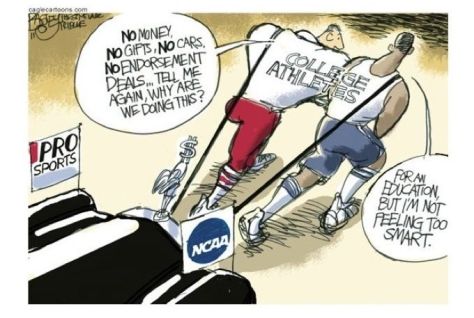
In preparing for this entry, not only did I read Hill’s piece a few times, but I also read a great piece of work by a young man named Joe Perry, “Exploitation of African-American “Student-Athletes”. [Side note: I used his graphic for this story because it was so fitting]
Now you may think that neither of these two articles have any similarities but they do; mainly, they talk about how the NCAA has monopolized and used so many talented African American athletes to the point to where they can be considered throw aways. And that’s not being harsh. As a senior writer for Blackathlete.net back in the day, my colleagues and I consistently mentioned this phenomenon back in the late 1990s and early 2000s.
And it still goes on to this day.
If that were not the case, the two articles I mentioned wouldn’t be so high up on the google Boolean search results page.
But here’s my question to everyone: why haven’t African American families pushed for their star athletes to go to these HBCU schools and basically not look at going to a Duke or Ohio State as the holy grail?
The answer, believe it or not, revolves around money; pure and simple.
MONEY IS THE ROOT TO ALL OF THESE ISSUES
For a star African American athlete to not consider going to one of the power 5 conferences is basically telling that family “Money can’t solve your problems”.
Let’s really be honest here: the ONLY reason Black Athletes are not going to Howard, FAMU, Grambling, etc. is because of the money.
It’s the money these kids look at if they perform well on the field.
It’s the money of endorsements…..shoe deals…and anything else you can think of.
It’s the chance to play in front of a big audience and be seen.
To practice at a top-notch training facility that is almost as good as the NFL or NBA; and in some cases, it is that good.
It’s the chance to show the sports world who this kid is.
Sadly, that’s just not there for any HBCU school.
Does that mean that these athletes don’t have a chance at being professional athletes?
No.
And that is where I think Hill was driving at in her piece.
The families of these athletes need to look beyond the obvious and think of the possibilities.
While an HBCU may not have the fancy workout spaces or have some really famous alumni rolling through on a summer day, what they can do is produce some Hall of Fame talent. Talent like Steve McNair, Michael Strahan, Jerry Rice and others.
[Check out the HBCUBuzz article, HBCU Athletes Picked In The 2019 NFL Draft, for a list of 2019 NFL draft picks from HBCU schools]
There’s plenty of talented HBCU players out there and sometimes it’s those kids who do better than the athletes who went to the Top 5 powerhouse schools.
EQUAL PLAYING FIELD….IN AND OUT THE CLASSROOM
Finally let me take this one step further than possibly what Hill and Perry were trying to get to. In order for African American athletes who are the top of their respective “games” to even consider going to an HBCU, there has to be an equalization not only on the field and in the weight room but also in the classroom.
Remember when I said money is the root? It’s the root here as well and that “racial” discrimination point I was making actually is a mask; it’s more of economic discrimination than racial here.
Basically, the haves and the have nots.
That’s the reality of this conversation and if it isn’t pleasant for some reading this blog; it wasn’t meant to be.
There is a reason why there are tiers in the NCAA when it comes to the economic streams of the NCAA. Power conferences rule; weaker conferences get “pay days”.
Power conferences get big time alumni support while HBVU schools struggle to sometimes even stay open; let alone do alumni fundraising.
Power conference schools can get big time shoe and tv deals; HBCU schools are just trying to make sure their kids are successful.
That’s not saying an HBCU education is devalued or not as good as one coming from a Texas, Ohio State or Baylor. Sometimes the best and brightest are those who did graduate from a school like East Tennessee State, North Carolina A&T or Morehouse.
So, before you go judge Hill and her work on this subject, check your bias against her at the door.
If you dig deeper into the subject matter what you will find is that where she is going is a spot that big time schools don’t always go to.
And sometimes that spot isn’t the “obvious” one you think you already know.
Gregory Moore is a former sports columnist and editor of a weekly African American newspaper in San Antonio, Texas as well as being a routine guest on various national sports radio and sports programming.

